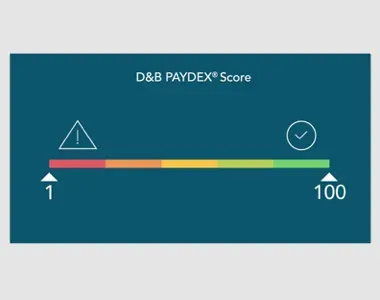
For any business, cash is oxygen, not just a line item on a balance sheet. This is particularly true for small and medium-sized businesses (SMBs) that often find it harder to secure loans or issue debt compared to their enterprise-level counterparts. In this environment, the order-to-cash cycle is one of the most critical spaces a finance team manages.
To manage this cycle, finance teams have historically relied on Days Sales Outstanding (DSO). However, as business cycles accelerate, relying solely on DSO has become increasingly dangerous. At Truverto, we’ve argued that DSO is a macro-level metric being mistakenly used for micro-level decisions. To truly protect your cash flow, you need to move from the "snapshot" of the balance sheet to the "video" of customer behavior: Average Days to Pay (ADTP).
In this article, we’ll explore why per-customer ADTP is the foundation of modern cash flow forecasting and how Truverto’s new automated tools allow you to predict, instead of guess, when your invoices will turn into cash.
Why DSO Is Lying to Your Forecast
Before we look forward, we must understand why the old way of looking back is flawed. DSO suggests it tells you the exact number of days a sale remains unpaid. In reality, DSO does not measure customer behavior; it measures portfolio balance.
Average Days to Pay (ADTP), specifically a weighted average (WADTP), is the "ground truth". It focuses exclusively on closed transactions, calculating the exact duration between the day an invoice was generated and the day the funds were settled.
| Feature | Days Sales Outstanding (DSO) | Average Days To Pay (ADTP) |
|---|---|---|
| Perspective | Macro/Financial: How much of total sales are "stuck" in AR? | Micro/Behavioral: How long does it actually take to get paid? |
| Sensitivity | High: Spikes in sales make DSO look lower/better. | Resilient: It only looks at completed payments. |
| Primary Audience | Investors, CFOs, Banks. | Accountants, Collections Managers. |
The Power of Granularity: From Portfolio to Customer
The fundamental limitation of DSO is that it is a single number for the entire company. DSO simply tells you how many days worth of sales your company has in accounts receivable on your balance sheet.
The true value of ADTP is that it can, and should, be calculated for each individual customer. This granularity is the engine of an accurate cash flow forecast. By tracking ADTP at the customer level, you can:
- Assessing Customer Risk: Identify exactly who is slowing down their payments over time before it becomes a crisis.
- Predicting Future Payments: Instead of applying a generic 30-day assumption to all outstanding accounts receivable, you can project payments based on how that specific customer has behaved historically.
Smarter Projections with Truverto
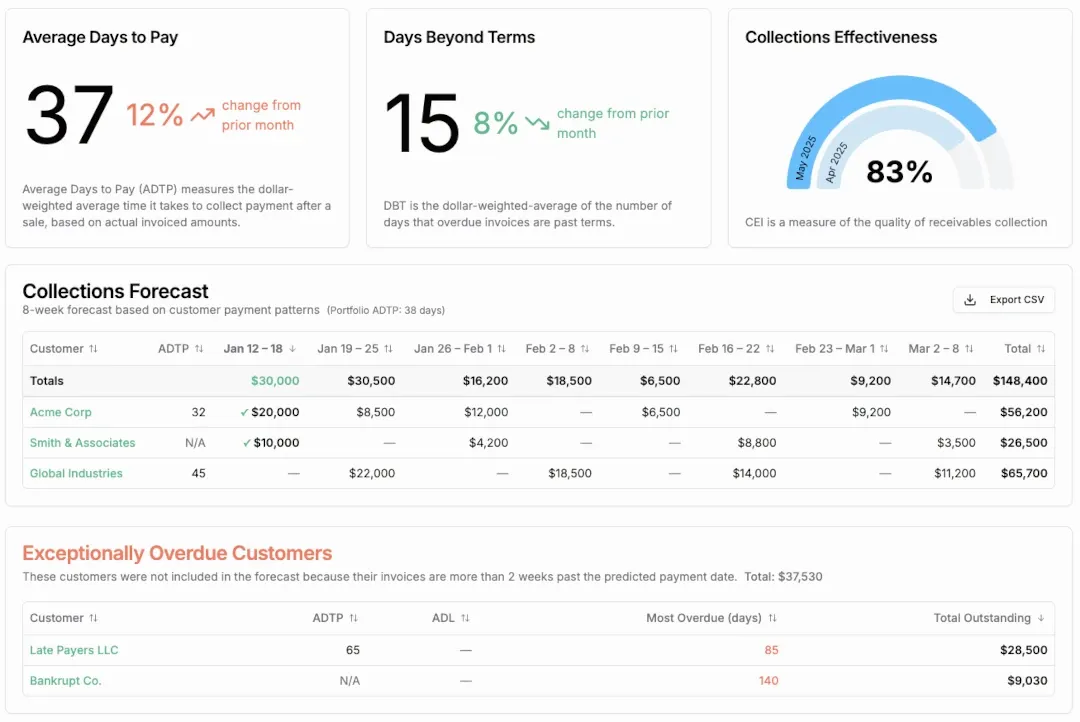
We have taken this per-customer intelligence and built it directly into the Truverto platform to automate your cash flow forecasting. Instead of guessing, Truverto uses each customer’s unique, historical ADTP combined with their specific invoice terms to project exactly when cash will hit your bank account.
How the Forecast Works
- Individual ADTP: Truverto analyzes the "video" of every customer's payment history.
- Invoice Terms: The system looks at the "Net" terms of the current outstanding invoice.
- Predictive Modeling: By combining the behavioral history (ADTP) with the contractual obligation (Terms), Truverto generates a predicted payment date.
- The Red Flag: If a payment hasn't been received as the predicted date approaches or passes, Truverto flags that customer. This allows your finance team to focus on accounts that are deviating from their normal behavior.
Supercharging Forecasts with External Intelligence
While customer-specific ADTP is a powerful predictor, the most dangerous risk is often the "hidden" one. This is the customer who pays you on time but is currently defaulting on their other vendors.
To bridge this gap, Truverto integrates internal payment behavior with external credit bureaus like Creditsafe, Dun & Bradstreet, and Experian. This creates a more comprehensive view of payment behavior.
The "Give-to-Get" Advantage
These credit bureau exchanges operate on a "give-to-get" model. By contributing your anonymized AR aging data, you gain access to more information about your customers and how they are paying everyone else.
By joining a Trade Payment Program (like those from Creditsafe or Dun & Bradstreet), SMBs can:
- Improve Payment Predictions: If a customer’s ADTP with you is 30 days, but their Days Beyond Terms (DBT) is spiking with ten other suppliers, Truverto can alert you and adjust your cash forecast to reflect a likely delay.
- Clean Your Records: Use legal names, subsidiary relationships, and office addresses from the bureaus to ensure your invoices are sent to the right place the first time.
- Minimize Fraud: Identify potential customer or payment fraud that could be hiding in bad debt.
Stop the Spreadsheet Nightmare
For many finance teams, the barrier to using metrics like ADTP or participating in credit exchanges is the sheer administrative burden. Manually exporting spreadsheets from your accounting or ERP, cleaning data, and running pivot tables often results in reports that are outdated before they are even finished.
Furthermore, manual participation in credit exchanges is a monthly headache of submitting files to credit bureaus that you have to format to each of their specific requirements.
Truverto eliminates this friction entirely.
- Seamless Integration: Truverto connects directly with QuickBooks, Microsoft Business Central, and Acumatica.
- Automation: We automatically extract the data, format it for the credit bureaus, and submit it on your behalf.
- Real-Time Insights: Your ADTP, risk scores, and cash flow forecasts are updated automatically. There is no manual review or cross-referencing required.
Conclusion: A More Trustworthy Economic Environment
In a fast-paced business environment, "gut feeling" and outdated macro-metrics like DSO are no longer good enough. Finance teams must be the guardians of truth within an organization. By owning data quality and moving toward the behavioral precision of ADTP, you aren't just cleaning up a spreadsheet—you are creating a more transparent and predictable future for your business.
By leveraging the combination of your internal payment data and external global credit intelligence, you can finally move from hoping you’ll get paid to knowing when the cash will arrive.
Ready to see your ground truth?
Small and medium-sized businesses can start using Truverto for free in just minutes. With our dedicated apps for Intuit QuickBooks and for Microsoft Business Central, your dashboard and automated collections forecast are just a few clicks away. No IT resources required.
By Brian Suthoff · January 23, 2026 · Updated February 4, 2026